


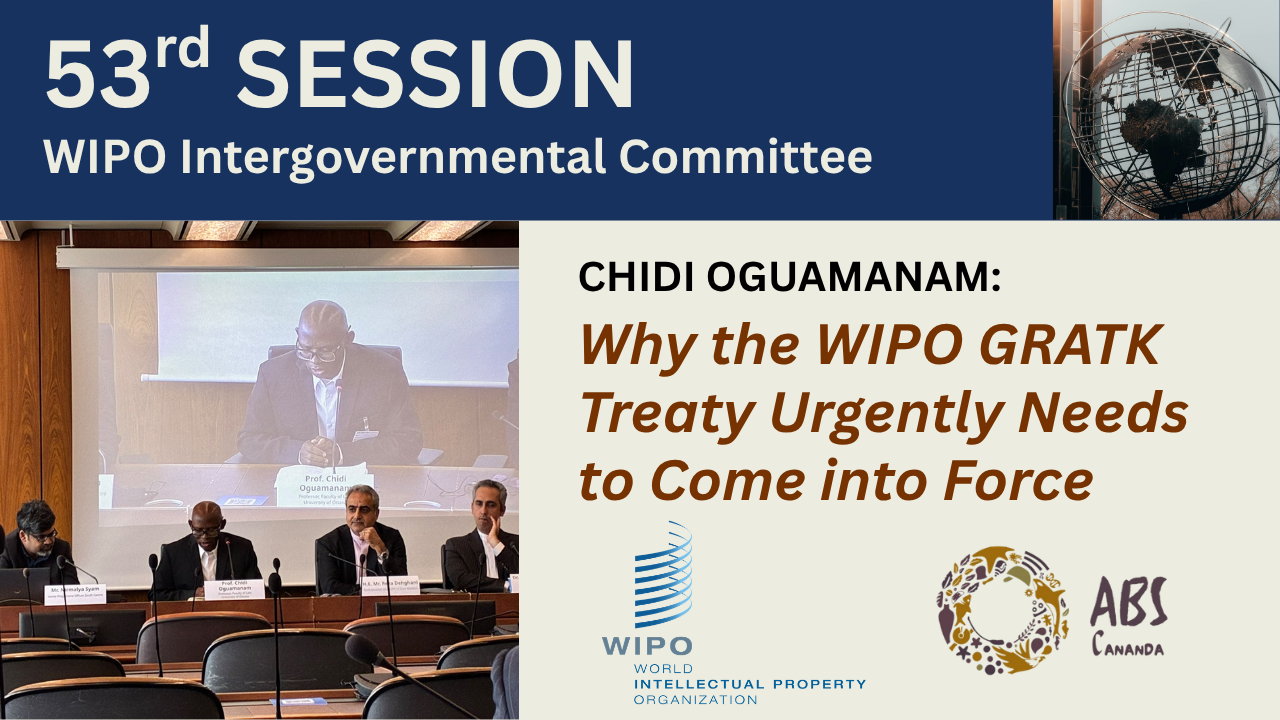
Why the WIPO GRATK Treaty Urgently Needs to Come into Force
Chidi Oguamanam delivered this remark on September 17, 2026, during the 53rd Sessions of the World Intellectual Property Organization’s (WIPO) Intergovernmental Committee (IGC) on Intellectual Property, Genetic Resources, Traditional Knowledge and Traditional Cultural Expressions as an invited panelist (in his personal capacity) to a side event organized and sponsored by the Permanent Mission of the Islamic Republic of Iran to the UN Office.
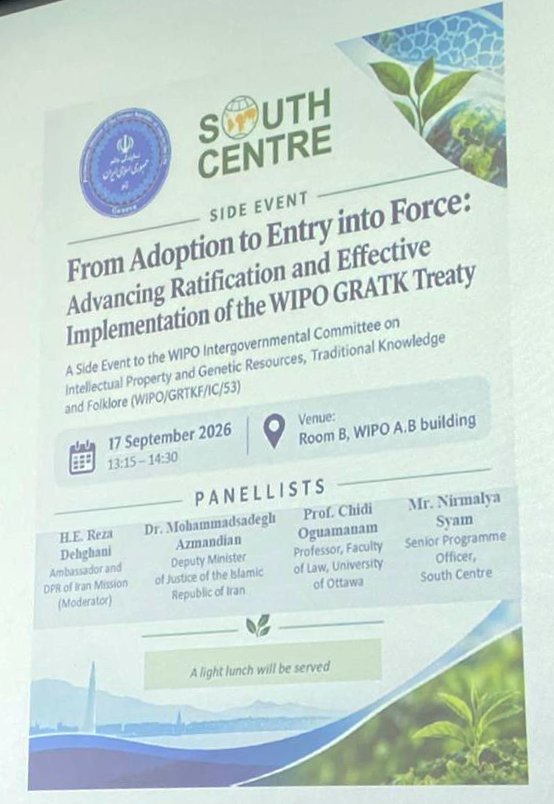
From Adoption to Entry into Force: Advancing Ratification and Effective Implementation of the WIPO GRATK Treaty.
Chidi Oguamanam:
I thank the Permanent Mission of the Islamic Republic of Iran to the UN in Geneva and H.E. Reza Dehghani (Ambassador and Deputy Permanent Representative) for inviting me to serve and share my insights as a panelist on this timely event, titled: “From Adoption and Entry into Force: Advancing Ratification and Effective Implementation of the WIPO GRATK Treaty” holding on the sidelines of the 53rd Sessions of the WIPO IGC. I thank my co-panelists, Dr. Mohammad Sadegh Azmandian (Deputy Minister of Justice) and Mr. Nirmalya Syam of the South Centre, Geneva. Finally, I thank the audience for making the time to be with us this afternoon.
To understand the significance of the GRATK [Genetic Resources and Associated Traditional Knowledge] Treaty, we need to pull back, even if arbitrarily, to the 1976 Tunis Model Law on Copyright, and the UNESCO/WIPO model provisions and international guidelines to protect traditional cultural expressions and folklore against illicit exploitation. We should also consider historic circumstances that demarcated UNSECO’s jurisdiction to “safeguarding” TK/TCEs (folklore) and tangible and intangible cultural heritages. These initiatives symbolize the push by the global South and Indigenous Peoples in both the global North and South to redress their historical exclusion and, by extension, the exclusion of their interests from the Western intellectual property system.
However, the 1994 TRIPS agreement was a game changer in reinforcing the colonial status quo because of its chilling silence on GRATK and TK/TCEs. The same forces that opposed the WIPO Treaty with a binding disclosure requirement in the patent system have resisted, since 2006, every attempt by the global South to correct the anomaly, especially through the amendment of Article 29 of TRIPS to include disclosure of GRATK in patent process at the TRIPS Council.
While the opposition to GRATK in TRIPS/World Trade Organization (WTO) raged, developments at the environmental law regime championed by the Convention on Biological Diversity (CBD) was more progressive, building consideration for access and benefit sharing through the Nagoya supplementary protocol on ABS. More than three decades of efforts to reconcile the artificially contrived chasm between the TRIPS agreement and the CBD did not yield any outcomes.
There is a time sensitive urgency for the Treaty to come into effect.
However, the closest to such an outcome is the 2024 WIPO GRATK Treaty. Even though negotiators did not directly link the GRATK Treaty to the CBD, the Treaty is a bold step in advancing ABS. Its potential implementation at various national levels cannot be divorced from progress and programs relating to ABS and environmental justice. The Treaty’s provision for mandatory disclosure in patent application is not an exercise that happens in isolation. Such disclosure ultimately has value in contributing to empowering GRATK holders, the ABS process and their contributions to biodiversity conservation and overall sustainable development among the world’s poor and stewards of global genetic heritage.
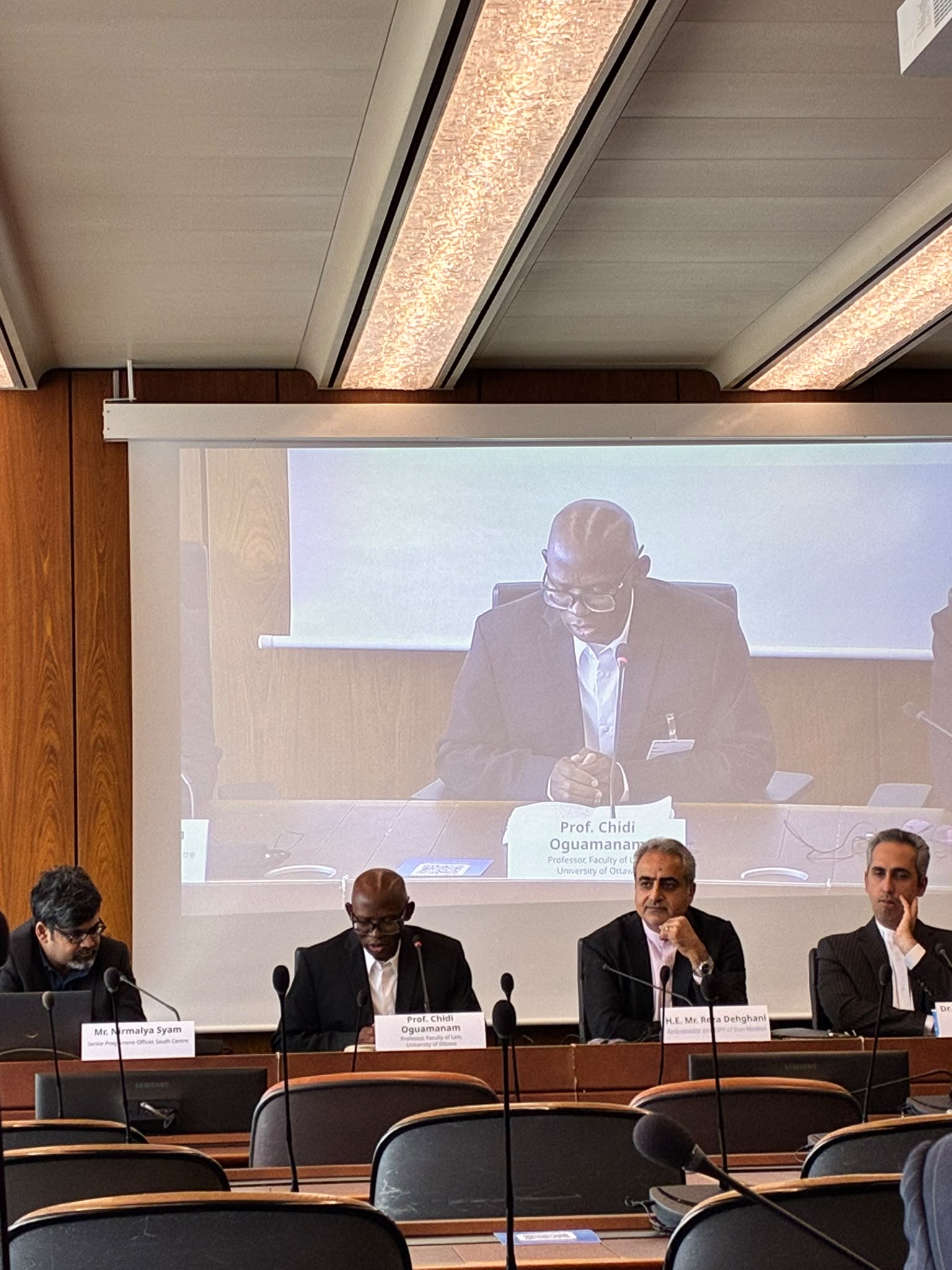
Chidi Oguamanam at the 53rd Sessions of the World Intellectual Property Intergovernmental Committee.
There is an urgent need to attain the 15 minimum ratifications required for the Treaty to come into force. The Treaty coming into force will mark a significant and meaningful milestone in effectuating the elusive rapprochement between the intellectual property and trade regime regarding GRATK. Perhaps most importantly, there is a time sensitive urgency for the Treaty to come into effect. This is because of the several issues that the Treaty kicked down the road, which will become the responsibility of the Treaty Assembly to address once it is constituted following the Treaty’s entry into force.
Some of the issues include, firstly, the details of the information system under Article 6, which requires active participation of IPLCs. The urgency could not be more compelling at time when the interface of GRATK with the digital space, especially AI, keeps GRATK stewards awake. The second issue concerns Article 8, where the Treaty left room for review in the direction of expansion of the mandatory disclosure to other areas of IP including derivates of GRATK, digital sequence information (DSI) and other issues related to “new and emerging technologies”. Third, Article 10(c) the Treaty provides for participation of IPLCs as accredited observers in the Treaty Assembly. This is a trailblazing provision that empowers IPLCs to an unprecedented degree, requiring early efforts to imagine how this provision could be operationalized and optimized. Lastly, if WIPO was to retain its advantage and attempt to reclaim its role in shaping a normative pathway for entrenching GR-TK/TCEs in the intellectual property system, it should not ignore – nor could it block – the Treaty Assembly’s predictable interest on how to render permanent TK issues in WIPO program of work. Counterintuitively, that expectation could lead to the idea of a Standing Committee on TK, rather than collapsing TK issues in the Standing Committee on the Law of Patents. Thus, the GRAK Treaty coming into force may have some unknown implications for the status of the IGC, especially the direction of its ongoing work on TK/TCE for which we are gathered here at 53rd sessions.
I conclude by noting that Nigeria is co-leading a cross-regional core group of champions of GRATK Treaty dedicated to achieving the number of ratifications and accessions to the Treaty to come into force. So far, four countries – Uganda, Malawi, Albania and Peru – have come on board, requiring only 11 other countries to meet the 15th ratification threshold. I am also aware that several other countries, including Iran, from the total of 44 countries that signed the Treaty at its adoption on May 24, 2024, are at different stages in the ratification and accession processes. Clearly, the countries that ratify or accede to Treaty will be able to shape the Treaty’s foundation and determine how much influence it can potentially wield in the WIPO and its litany of treaty regimes. I look forward to questions and further reflections.

Chidi Oguamanam at the 53rd Sessions of the World Intellectual Property Intergovernmental Committee.

Suggested citation for this blog post:
Chidi Oguamanam, “Why the WIPO GRATK Treaty Urgently Needs to Come into Force” (September 20, 2026), online: <https://abs-canada.org/why-the-wipo-gratk-treaty-urgently-needs-to-come-into-force/>

