


Language as Knowledge: Preserving Indigenous Languages as Carriers of Ecological Wisdom
Overview
On April 20, 2026, the Centre on Environmental Justice in Africa (CEJA) at the University of Pretoria (Hatfield Campus) organized a day-long workshop on the role of Indigenous Knowledge Systems in advancing sustainability, environmental stewardship, and climate resilience, and their relevance to contemporary law and policy. The Centre conducted this highly resourced and resourceful workshop in partnership with Earthrise Collective, UN Human Rights (Southern Africa Regional Office), the South African Human Rights Commission, and the Centre for Human Rights (University of Pretoria). The purpose of the event was to provide a platform for attendees to engage with the practical dimensions of Indigenous Knowledge Systems. The event explored how these systems can inform contemporary law, policy, and scientific practice. This engagement ably anchored by CEJA’s Acting Director, Dr. Abimbola Olowa, brought together diverse voices to share knowledge and foster meaningful exchange.
Speakers included academics and Indigenous Knowledge Systems activists such as Pooven Moodley, Prof. Magda Minguzzi, Prince Atawé Akôyi Appolinaire Oussou Lio (Benin Republic), Sinegugu Zukulu, Prof. Sumaya Adam, and Ivan Vaalbooi. Attendees included students, lawyers, rights activists, Indigenous community leaders and knowledge holders, agricultural practitioners, architects and green building practitioners, community-based organizations, and community members.
Speaking on behalf of ABS Canada, Prof. Oguamanam’s intervention focused on “Language as Knowledge: Preserving Indigenous Languages as Carriers of Ecological Wisdom”. The presentation explored the religious, philosophical and ontological intersection of language as a carrier of Indigenous ecological knowledge and wisdom, as well as Indigenous self-determination, worldviews and identities. It also highlighted the alarming statistical red flag over the fast disappearance and dormancy of many of the world’s Indigenous languages.
Prof. Oguamanam’s presentation drew depth from scriptures, philosophies and ecology, epistemologies and academic repertoires across multiple disciplines. Here is a sketch of some of his submissions.
The Symbiosis of Language, Knowledge, and Ecology
“A person’s tongue can give you the taste of their heart” Ibn al Qayyin
“Out of the abundance of the heart, the mouth speaks” Matt. 12:34

Photo courtesy of Hannah Wright, Unsplash.
Language as Mother Tongue and Gatekeeper to the Heart of Knowledge
Indigenous languages are a vehicle for communicating Indigenous Knowledge Systems and Indigenous ecology, worldviews, and wisdom. The diversity of Indigenous languages reflects ecological, epistemic, biological, and ecosystem diversity with deep philosophical sophistication and nuances. Languages give form and hidden wisdoms of the heart, mind, soul, and inner being. They reflect worldviews of phenomena. At the heart of Indigenous languages, we find stories about nature and ecological relationships expressed in philosophical depth and in robust artistic renditions.
Linguistic, Cultural and Ecological Diversity
The correlation of linguistic, cultural and ecological diversity is not an accident. There are 4,000 Indigenous languages out of approximately 6,700 languages in the world. However, 1,600 of Indigenous languages (40%) are at the risk of extinction or dormancy. The implication of that risk is not limited to the languages themselves, but it is also an ominous signifier of threat to what the languages carry, which has implication to the sustainability of diversities of humanity’s lived experiences on the Mother Earth. Language is the life wire and carrier of human socio-cultural experience and sustainability. Those shrink with each language that goes dormant or extinct.
Epistemic Linearity in Widespread use of Colonial Languages
On the other hand, the widespread use of colonial languages means more linearity, homogeneity, formality, and epistemic limitations in ways that shrinks human sustainability potential. Colonialism disrupts linguistic and epistemic justice. Indigenous languages and cognate knowledge systems and ecological wisdom provide a channel for re-thinking colonial knowledge governance and power models. Reliance on colonial languages involves homogenization of ways of knowing, imposition of hierarchies of cultures, the destruction of cultural agency of Indigenous peoples, and Western scientization of Indigenous knowledge and phenomena. In legal matters, colonialism also enables intellectual poverty and intellectual property overreach. The latter happens often through bioprospecting and biopiracy that harnesses and detaches Indigenous knowledge production, its cultural roots and linguistic grounding.
The Role of Linguistic Diversity in Knowledge Production and De-colonization
Indigenous ecological knowledge includes knowledge about Earth-living and non-living life forms in their complexity, diversity, and relational dynamics. It encompasses systems-based spirituality, diverse habitats, behavioural dynamics, ecosystems transformations, and place-based knowledge production. Land is at the core, hence the unfathomable philosophies and epistemologies expressed in the “Mother Earth” epithet.
Indigenous languages drive ecological wisdom in disseminating and passing down ideas of holism, harmony, egalitarianism, unity, and interdependence of complex relationships of living and non-living life forms, as opposed to a the selective “subdue and conquer” ideology that often acquits humanity from ecological accountability and environmental responsibility.
Recovering the Past, Engaging the Present, and Negotiating the Future
Efforts at reviving Indigenous languages should aim at valorizing its epistemic value and the diversity imperative for robust knowledge production. These efforts require a conversation about” human civilization where it is important to focus reflexively on coloniality, history, power, identity, sustainability, inclusive and alternative visions of development.

Photo courtesy of Donald Wu, Unsplash.
The modern world is evolving quickly. The rapid changes enable new sites of knowledge production and innovation, such as datafication, digitization, artificial intelligence, etc. These new technologies could be designed at foundational level ask the “Indigenous/Traditional Knowledge Question”. It is a question of epistemic justice, epistemic pluralism and integrity. They must have inbuilt capacity for both inclusive representations (for example in contemporary content aggregation and AI large language training model) and for resisting top-down epistemic transmissions.
To sustain and revive Indigenous languages, knowledge systems, and ecological wisdom, policymakers must promote an integrated policy framework, aligned to integrated approach to education that encompasses humanities, technologies and Indigenous Knowledge Systems. University of Pretoria’s Future of Africa Hillcrest Campus is leading this model of multidisciplinary learning. Sustaining these knowledge systems requires a commitment to reimagining progress in ways that are inclusive, equitable, and ecologically grounded. IKS, including Indigenous languages are culturally rooted scientific endeavours. They are no less sites for knowledge production than colonial scientific and linguistic frameworks which have been historically weaponized as tools of domination and subjugation of alterity in a global knowledge framework that reifies the tyranny of civilizational and epistemic minority.
Credits for this Special ABS Canada Reportage/Blog: Rahma Wiryomartono, Chidi Oguamanam
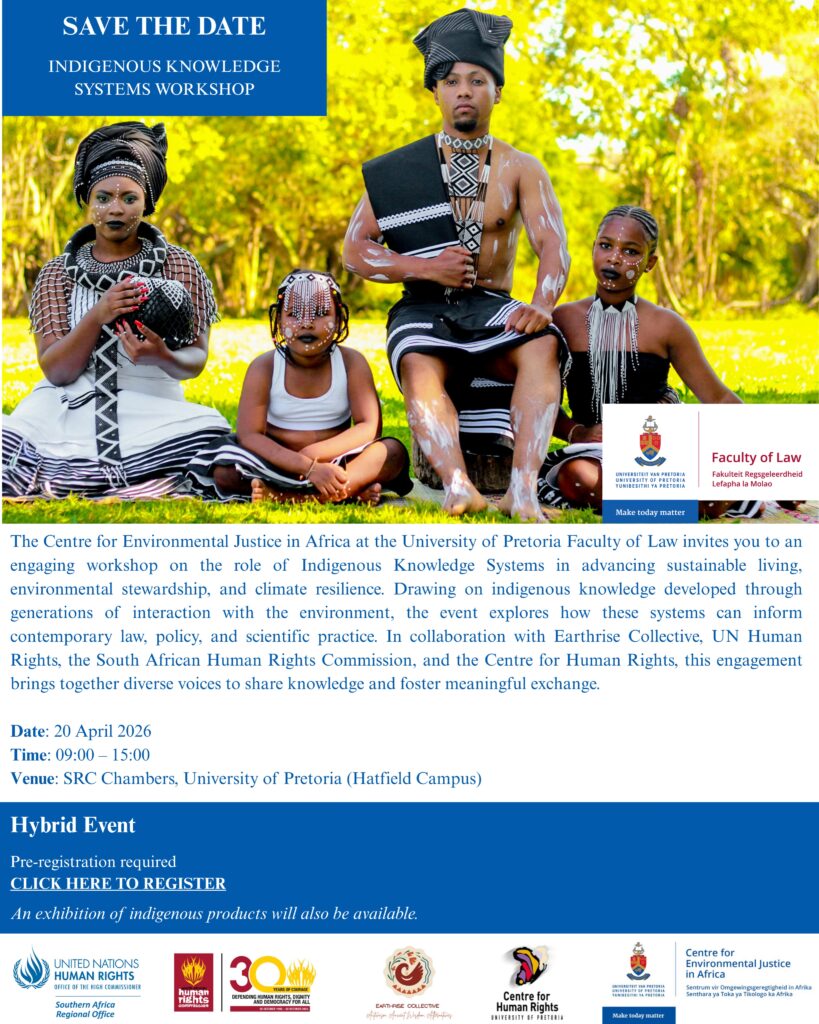
Indigenous Knowledge Systems Workshop Flyer, April 20, 2026

Co-Written by Rahma Wiryomartono
Rahma is a Research Fellow at ABS Canada and a law student at the University of Ottawa. Having worked in Canada, Japan, and Indonesia, she is interested in international law, intellectual property law, human rights, and how they intersect with Access and Benefit Sharing.

Suggested citation for this blog post:
Chidi Oguamanam & Rahma Wiryomartono, “Language as Knowledge: Preserving Indigenous Languages as Carriers of Ecological Wisdom” (June 1, 2026), online: <https://www.oguamanam.com/publications/preserving-indigenous-languages-as-carriers-of-ecological-wisdom>

