

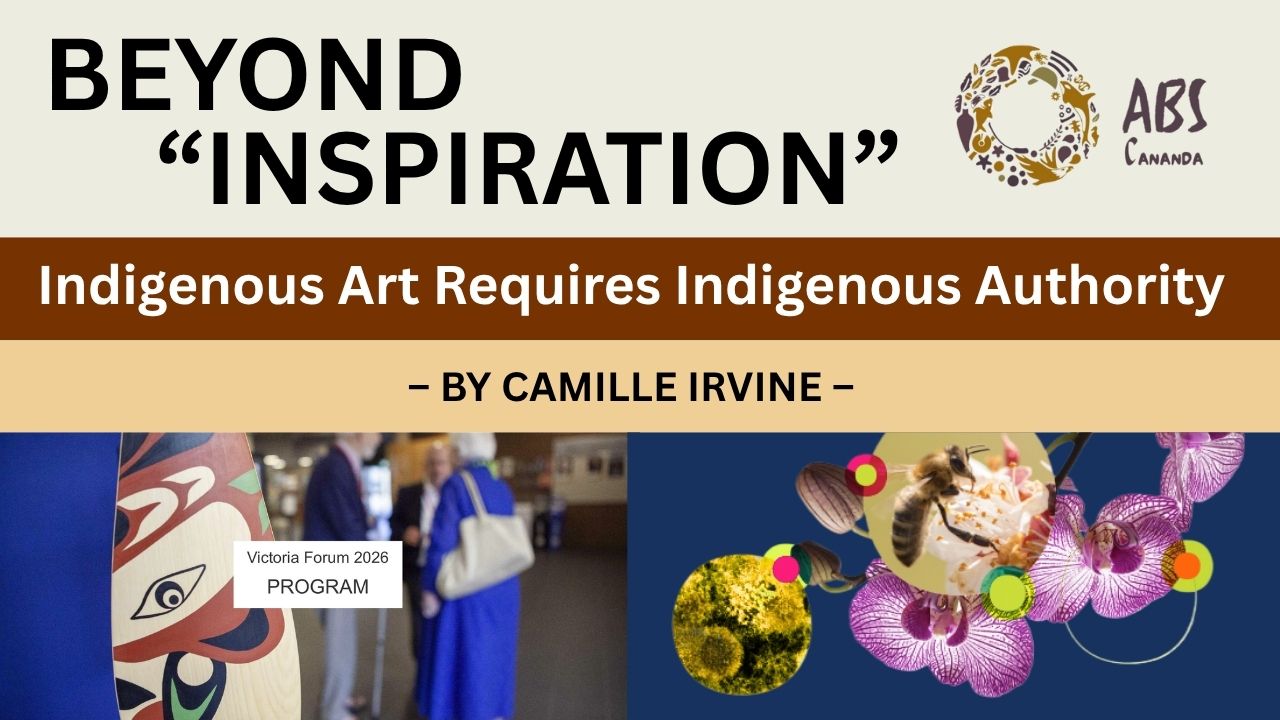
Beyond “Inspiration”: Indigenous Art Requires Indigenous Authority
When Indigenous art is copied, the harm cannot be measured only by asking whether a particular design was reproduced closely enough to violate copyright. That question begins too late and captures too little. Indigenous artistic expressions can carry laws, histories, relationships, responsibilities, and identities. When they are removed from those systems and sold as merely “Indigenous-inspired,” what is taken is not only an image. Authority is taken too.
A roundtable held at the 2026 Victoria Forum, Beyond Cultural Inspiration: Indigenous Art, Appropriation, and Protecting Sacred Expression, brought these issues front and centre. Moderated by Tarrin Sam, Executive Director of the Indigenous Prosperity Centre, the discussion brought together master carver and public advocate Richard Hunt; Indigenous business scholar Tasha Brooks; Kari McLay of the Victoria Native Friendship Centre; Matt Vickers of Northern Nations Co-operative and Vickers & Associates; and the writer, an associate and researcher with the Access and Benefit Sharing Canada Project at the University of Ottawa Faculty of Law.
Across the practices one point emerged: protecting Indigenous art requires respecting Indigenous peoples’ authority to decide what may be shared, by whom, on what terms, and for whose benefit.
From Suppression to Appropriation
Kari McLay challenged the language of “inspiration.” It can sound respectful while disguising exploitation: a business copies an Indigenous visual tradition, outsources production, and excludes the people from whom that tradition comes.
This happens within a longer colonial history. Systems that once suppressed Indigenous ceremonies and cultural practices now allow businesses to profit from the expressions that survived. The problem has shifted from prohibiting Indigenous culture to consuming it without Indigenous control.
Indigenous artistic expressions can carry laws, histories, relationships, responsibilities, and identities
Drawing on her family’s history with Indigenous art and her work on the Victoria Native Friendship Centre’s Cowichan Sweaters: Knit with Purpose initiative, McLay described authentic Cowichan sweaters as products of living knowledge and skilled labour, not simply a retail style. Ethical collaboration puts knitters in the driver’s seat from the start, pays them fairly, and tells their stories accurately.
Art Is Not Separate from Law
Richard Hunt and Matt Vickers made clear why the distinction between art and authority matters.
Hunt described seeing his work reproduced on products made and sold far from his community. In one instance, an image of one of his masks was made to appear three-dimensional and printed on vinyl. Even where an artist might have a legal claim, litigation can be too costly, slow, and uncertain to offer a practical remedy. An online seller may disappear and reappear under another name.
Vickers explained that Northwest Coast art is not a generic style anyone can rearrange. Designs, crests, stories, songs, and names may belong to particular nations, clans, or families. Indigenous laws govern who may hold and share them. Vickers described turning down commissions outside his own cultural and territorial authority and directing clients to artists from the appropriate nation. That is not simply professional courtesy. It is respect for law.
This point unsettles a basic assumption within the Canadian intellectual property system. Canadian law generally begins by identifying an individual author, a fixed work, a defined owner, and a limited term of protection. Indigenous legal orders may instead recognize authority held by a nation, clan, or family, along with responsibilities that do not expire on a statutory date.
When Canadian law recognizes only its own categories, conduct that violates Indigenous law can appear legally harmless. For example, a design may be considered available for public use even though community law continues to restrict who may reproduce it. A dance or story may receive inadequate protection because it does not fit requirements designed around fixed, individually authored works. A company may avoid using a protected authenticity label while still copying the appearance and cultural value of the tradition behind it.
Economic Development on Indigenous Terms
Protection cannot be separated from economic opportunity. Tasha Brooks explained that Indigenous artists are also entrepreneurs, but the systems around them do not always provide the tools needed to turn demand into sustainable livelihoods. She identified three connected needs: capital and practical tools, access to markets, and governance systems made by Indigenous peoples.
Brooks also highlighted pricing and long-term financial security. Indigenous artists should not have to choose between protecting culture and earning a living. Support with technology, pricing, marketing, succession planning, and legal advice can help artists earn a living while strengthening family and community relationships.
The panel therefore resisted a false choice between preservation and commercialization. The issue is not whether Indigenous art may enter markets. Indigenous artists and communities have always adapted, innovated, and traded. The issue is who controls that participation, who receives the benefits, and whether commercial relationships respect the laws and responsibilities attached to the art.
From Recognition to Authority
The United Nations Declaration on the Rights of Indigenous Peoples offers a starting point. Article 31 recognizes Indigenous peoples’ right to maintain, control, protect, and develop their cultural heritage, traditional knowledge, traditional cultural expressions, and associated intellectual property. Articles 11 and 34 also speak to cultural practices and Indigenous legal systems.
Canada’s United Nations Declaration on the Rights of Indigenous Peoples Act requires the federal government, in consultation and cooperation with Indigenous peoples, to take all measures necessary to ensure federal laws are consistent with the Declaration. Recognition, though, must become workable authority, remedies, and resources.
That means supporting Indigenous-led systems that can determine who may authorize a cultural expression’s use, which uses are prohibited, how benefits are shared, and what happens when rules are broken. Different nations will answer those questions differently. A credible approach must leave room for that diversity.
Beyond Appreciation
The panel ended with a straightforward message: learn about Indigenous art, support Indigenous artists, and buy Indigenous. Those actions matter. Governments, businesses, galleries, consumers, and legal institutions must also ask who holds authority, seek consent before acting, build relationships with the appropriate people, pay artists fairly, and accept that some expressions are not available for commercial use.
The central lesson I took from the panel is that appropriation is not only a failure of attribution. It is a failure to recognize Indigenous jurisdiction. Canadian intellectual property law may offer useful tools in particular cases, but it cannot provide a complete answer while treating Indigenous law as cultural context rather than law.
Moving beyond “inspiration” therefore requires moving from acknowledgment to authority. Indigenous artists and communities should not have to prove that their traditions resemble Western property closely enough to deserve protection. The legal and commercial systems engaging with those traditions must learn to recognize the Indigenous laws that already govern them.

Suggested citation for this blog post:
Camille Irvine, “Beyond “Inspiration”: Indigenous Art Requires Indigenous Authority” (October 15, 2026), online: <https://abs-canada.org/beyond-inspiration-indigenous-art-requires-indigenous-authority/>
