


Indigenous Peoples and Local Communities’ Decolonial Struggle over Transplanted Western IP
This blog post is based on Prof. Oguamanam’s contribution at a panel, “Indigenous Legal Orders, Legal Pluralism, and the Coloniality of Method in Global Governance,” hosted by American Branch of the International Law Association on June 1, 2026.
“When a Plant is transplanted without sensitivity to the ecology of its new destination, it risks dying or becoming an invasive weed that kills off native species while disrupting the ecology and ecosystem of its new environment”.
Introduction

Photo courtesy of Markus Spiske, Unsplash.
The above metaphor is rooted in “natural law” – it is an empirical biological as well as broader scientific truth. Its moral is rooted in African philosophy. It is also shared in various renditions across the world’s diverse epistemic traditions. The metaphor captures intellectual property (IP) law’s experience with Indigenous Peoples as well as local communities (IPLCs) and their Indigenous Knowledge Systems (IKS). That connection is an integral aspect of colonialism and its later mutation to globalization. IP’s intersection with IKS and its experience with IPLCs of the global south and global north is a site of historical and colonial relations of power that perennially exposes epistemic injustice. Like all things colonial, the transplanted IP plant did die. It was backed by enormous suppressive power. In a way, it can be likened to invasive species; not a weed in the real sense. However, it failed to kill native species, that is, IKS. Rather, it disrupted the knowledge production ecology and ecosystem of IPLCs. The disruption is monumental and irrecoverable.
In the past several decades, IPLCs and their knowledge systems have constituted a source of pressure and of epistemic resistance, challenging and exposing the limitations and gaps in the Western IP system and questioning the legitimacy of its universalization after the colonial fashion. IPLCs have done this as a strategic endeavour through multidimensional solidarity and, perhaps most importantly, across multiple regime complexes that have not only questioned the orthodoxy of IP but also decentralized its discourse. A few instantiations of the foregoing claims across multiple regimes will suffice.
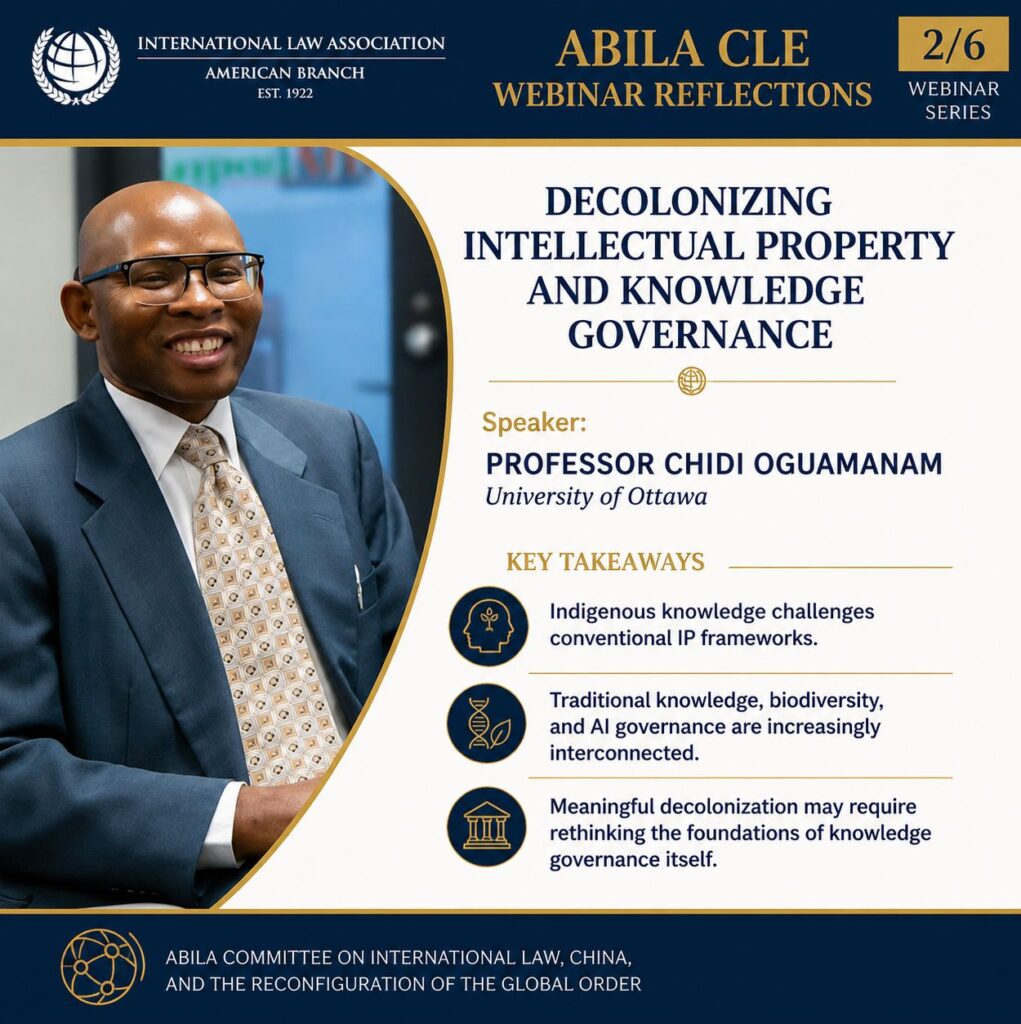
Overview of Prof. Oguamanam’s presentation. Visual courtesy of Paolo Davide Farah of the American Branch of the International Law Association.
On the Environment
-
- Agenda 21 of the Convention on Biological Diversity (1992)
- Nagoya Protocol (2010)
- The Paris Agreement (2015)
- UNCLOS/BBNJ (agreement on the conservation/sustainable use of marine biological diversity of areas beyond national jurisdiction) (2023), etc.
The above contributions of IPLCs and IKS shifted thinking on biological resources from common heritage to sovereignty right of source nations. Those contributions are now central to international law and policymaking for innovations relevant to biodiversity and marine genetic resources conservation, biotechnology, climate change, and the like.
On Health
Indonesia’s case for viral sovereignty in 2011 resulted in the Pandemic Influenza Preparedness (PIP) framework. The PIP became the foundation for new discourse about equity through benefit sharing (of vaccines and antivirals) in global public health. That thinking is now part of post COVID-19 global public health headlined by the 2025 Pandemic Agreement (Article 12, Pandemic Treaty’s ABS Annex).

Photo courtesy of Nappy Studio, Unsplash.
On Agriculture
The Food and Agriculture Organization’s International Treaty on Plant Genetic Resources for Food and Agriculture (2001) is the first major ABS treaty. Article 9 outlines farmer’s rights as a counterpoise to plant variety protection rights, which only caters to the interests of hi-tech plant breeders. Farmer’s rights symbolize the endurance of the culture in agriculture, the traditional legacy of reproductive agriculture as opposed industrial or productive agriculture that restricts the regenerative capacity of seeds and other propagating materials.
On Human Rights
Within the core IP domain, IPLCs and their knowledge systems have pushed the envelope for mapping the IP and human rights interface, which is captured in the 2007 UN Declaration on the Rights of Indigenous Peoples (UNDRIP). UNDRIP provided the ideological fuel for IPLCs to challenge the rebuff of the 1994 Trade-Related Aspects of Intellectual Property Rights (TRIPS) Agreement. TRIPS is silent or, so to say, does not recognize Indigenous knowledge and its custodians as stakeholders in a globalized IP system.
Post-TRIPS Backlash

Prof. Oguamanam speaking at the ABILA Webinar. Screenshot courtesy of Neha Bhardwaj.
There are several bases to substantiate the contributions of IPLCs in the post TRIPS backlash. Through their voices, IPLCs provided legitimacy to the WIPO in framing TK/IK as a major IP issue of our time (1998/9). That awareness provided impetus to the establishment of the Intergovernmental Committee on Intellectual Property, Genetic Resources, Traditional Knowledge and Folklore (WIPO IGC). After 24 years of tenacity and strategic solidarity of IPLCs and their allies, the IGC delivered the first major development-focused IP treaty centered on the intersection of the patent system and IKS – the 2024 Treaty on Genetic Resources and Associated Traditional Knowledge (WIPO GRATK Treaty).
WIPO GRATK Treaty
Jurisprudentially, this treaty is an accountability and transparency mechanism that confronts the hitherto opaque patent system. It builds on UNDRIP principles and progress made at CBD over access and benefit sharing. It mandates disclosure of origin or sources of genetic resources and traditional knowledge upon which a patent claim is based.
Counterhegemonic Responses
Even though conventional IP has caused havoc on IKS through colonial power relations of denial, denigration and appropriation, it has also stirred counterhegemonic and subversive responses. Those are symbolized through several new discourse and policy tractions, including biopiracy, access and benefit sharing, and cognate elements such as free prior and informed consent, and the practice of consultation and participation of IPLCs in IP decision making and broader knowledge governance. The WIPO GRATK treaty has further strengthened IPLCs’ role in the IP space.
New Technology Frontiers
IPLCs have remained unrelenting in decolonizing the IP system. They consistently and strategically inject concerns for ethics, equity, distributive justice and the inclusion of their interests and representation in shaping the foundations of emerging technology frontiers. Examples of engagements in the new technology frontiers include discourses about datafication, Indigenous data sovereignty, digital sequence information, text data mining, large language models and natural language processing in the overall AI ecosystem.

Visual courtesy of Conny Schneider, Unsplash.

Suggested citation for this blog post:
Chidi Oguamanam, “Indigenous Peoples and Local Communities’ Decolonial Struggle over Transplanted Western IP” (June 16, 2026), online: <https://abs-canada.org/indigenous-peoples-local-communities-decolonial-struggle-over-transplanted-western-ip>

